



A Conversation with the Author of “Psychedelic Buddhism: A User’s Guide to Traditions, Symbols, and Ceremonies”
Lama Mike Crowley is a unique figure in the world of Buddhism. Born in 1948 in Wales, he moved to London in 1967, where he befriended a Tibetan Lama and became his student. He became and upasaka (ordained layman) of the Kagyud lineage on May 1st, 1970 and was ordained as a lama on January 1st, 1988. Known for his expertise in the intersection of psychedelics and Buddhism, Crowley has lectured worldwide on the topic and recently released his book, “Psychedelic Buddhism: A User’s Guide to Traditions, Symbols, and Ceremonies.” In this podcast, we delve into Mike’s journey and discuss his book’s exploration of psychedelics and Buddhist practice.
The Journey to Buddhism
Mike Crowley embarked on his journey to Buddhism in 1967 when he met a Tibetan Lama in London who would become his mentor. After years of diligent study, he received the Psaka (Layman) ordination in May 1970 in the Kagyud lineage of Tibetan Buddhism. In 1987, he became a fully ordained Lama, cementing his commitment to Buddhist teachings and practices. To further his studies, he learned Sanskrit, Tibetan, and Mandarin Chinese. He has shared his expertise through lectures at institutions such as the Museum of Asia and the Pacific, Warsaw, and the University of Wisconsin-Madison. His work has been published in respected publications such as Time and Mind: The Journal of Archaeology, Consciousness, and Culture, and Psychedelic Press UK. In 2016, he received the R. Gordon Wasson Award for his outstanding contributions to the field of entheobotany. Currently, he serves on the advisory board of the Psychedelic Sangha, a group of psychedelically-inclined Buddhists based in New York, and teaches at the Dharma Collective in San Francisco.
Psychedelic Buddhism: A User’s Guide to Traditions, Symbols, and Ceremonies
Crowley’s book, “Psychedelic Buddhism: A User’s Guide to Traditions, Symbols, and Ceremonies,” serves as a comprehensive guide for those interested in exploring the intersection of psychedelics and Buddhist practice. The book presents guidance and techniques for Buddhists looking to incorporate psychedelics into their practice, as well as for psychonauts who are interested in the inner space maps provided by Buddhism.
The book explores the use of psychedelics in Buddhist practice, sharing the types of spiritual experiences that can be gained with each. Crowley also describes meditation techniques, with special attention given to the generation of the Four Positive Attitudes.
A Conversation with Lama Mike Crowley
In our conversation with Mike, we discuss his book and learn more about his unique Buddhist lineage. Mike shares insights into the integration of psychedelics into Buddhist practice, the potential benefits of combining these two powerful forces, and the importance of proper guidance and preparation for such experiences.
Lama Mike Crowley’s work brings together the worlds of Buddhism and psychedelics, offering valuable insights for both Buddhists and psychonauts alike. His book, “Psychedelic Buddhism: A User’s Guide to Traditions, Symbols, and Ceremonies,” is available now on Amazon and from all good booksellers. For those looking to explore the intersection of these two transformative practices, Crowley’s guidance and wisdom serve as a valuable resource.
The book –
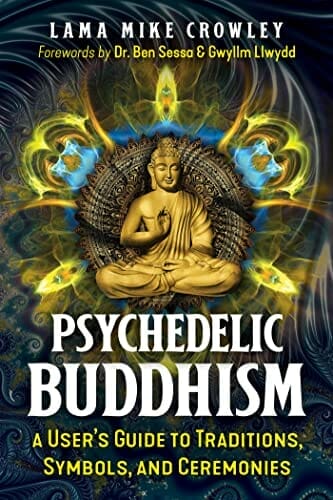
https://www.amazon.com/Psychedelic-Buddhism-Traditions-Symbols-Ceremonies/dp/1644116693/ref=sr_1_1
Transcript
(00:00)
In one case, I gave a very detailed visualization called the four Brahma Viharas, which are four stages to be inculcated, to be encouraged. They are love, compassion, sympathetic joy, and equanimity. Welcome to Supernormalized, where we delve into the world of alternative experiences, spirituality, consciousness, and personal growth. I'm your host C J Barnaby, and today we have a truly unique and fascinating guest joining us, Lama Mike Crowley, a renowned figure in the world of Buddhism. Has dedicated his life to the study and practice of Tibetan Buddhism, and has a particular interest in the intersection of psychedelics and Buddhist practice. Born in Wales in 1948, Mike moved to London in 1967, where he met a Tibetan Lama who became his mentor, fast forward to today, and Lama Mike Crowley is a respected teacher, lecturer, and now author of the book Psychedelic Buddhism: A User's Guide to Traditions, Symbols, and Ceremonies. In today's episode, we'll be discussing Mike's journey into Buddhism, his exploration of the connection between psychedelics and Buddhist practice, and what he shares in his book. So, without further ado, let's dive into this enlightening conversation with Lama Mike Crowley. I was thinking to interview you today about your history and then how you became a Lama, and then your inspiration for the book, and yeah, and anything else you'd like to talk about around it. Okay, well, I started my career, I guess, in high school, and I was a convinced atheist at the time. And then was an event when I was 50. It was towards the end of the school year. We we'd done all our classes for that year, and there was another school locally, which was having a week of various speakers and.
(03:00)
The workshops with those speakers, and I looked at it and I thought, wow, that's great. On four of the five days, there were left-wing political speakers that I would be really interested in. The only, the only day without anything interesting was Tuesday, and that had somebody speaking on apartheid in South Africa, which I was thoroughly against. And the other guy was a Buddhist, and he was telling people about Buddhism, and I, I went along just to make trouble. I thought I would ask him all sorts of awkward questions about his bizarre Oriental cult, and I asked him questions, and he gave me really sensible answers. The answers I really would have come up with myself, I guess. And after the talk, I went up to him and said, where can I find out more about this? And he was astonished. He said, I thought you were against it, and I said, no, you gave me all the right answers. I want to know what the what the fundamental beliefs of Buddhism. So that started me. Every time I went up to London, I would visit the Buddhist Society, avail myself of various free publications, and eventually, when I moved up to London, I I became a member and avail myself of the library. I had a neighbour at the time, he lived three doors away. Yes. And he every Saturday he would go to all the local jumble sales. Do you have the term of Australia? Yeah, yeah, garage sale. Yeah, it's a, it's a, it. I don't think it's exactly a garage sale. People from all an entire neighbourhood would. Oh yes, yes. Car boot market. Yeah, exactly. There you go. And and they would take stuff to the the local church hall or whatever, and this guy would go to at least three of them every Saturday morning. Yes. And he'd run and say, yes, that, that, that, that, and he would be gone. And he was he would accumulate an attic full of treasures to be plundered in his old age.
(06:00)
And he would just he would just take these things and vacuum seal them in plastic, so he wasn't going to see them again till he was sixty five. And anyway, one day he, or every Saturday after doing the rounds of the dabbles in the morning, he would come to where my girlfriend and I were living and show us his treasures that he had accumulated in the morning. And I mean, she got an incredible Russian symbol fur coat needed a new lining, but it was intact. Anyway, he showed me this brass object, kind of a pointy thing with three blades at one end blunt blunt blades. But he he said, "What do you think this is?" And I said, "Oh, that's that's Tibetan. That's a, I've got a picture of one in the book." And and he said, "No, no, I think it's Mexican." And I said, "I'll get the book and show you." So I got the book, showed it to him, and he said, "You're right. It's the same here. Have it." And I said, "I can't possibly afford something like that." And he said, "No, no, no. It only costs me a few pennies. You take it." So there I had the object, and all I had in the book was a photograph. It didn't explain anything at all. It just said Tibetan ritual implement. And so I took this ritual implement to the Buddhist Society in Eccleston Square and asked if they had any books on such things. And I was told I'd already taken out all three books they had on Tibetan Buddhism. And however, there was a Lama, a Tibetan refugee, who had just taken residence in London at the the Society of Friends Youth Hostel, and she she rang him and asked if it would be okay for me to take this thing over to him. And I did, and he made me a cup of tea with said them chatting, and I asked if it would be okay. Eventually, asked if it would be okay for me to come back next week. It was a Friday, and I had Friday's off at jobs, so I saw him every Friday without interruption for the next seven years. Oh.
(09:00)
That he he is the the Tibetan Lama who ordained me and I became a genyen, an upasaka in Sanskrit on May the first nineteen seven and I became a Lama on January the first nineteen eighty. Wow. So that's stuff. And that's your origin story. Your origin story. That's my origin story. Yeah, that's very good. Well over the years I have accumulated a lot of bits and pieces of the tradition. And been to various pilgrimage places in India and China. And what was what was the object? What was the object there? The copper tube with the three knives. Can you describe what that was? Oh oh that was a puuba puuba. Yes in Tibetan it's called puuba which is sometimes written p apostrophe uab and it had it had these these three blades that came to a point and at the other end at the other end were were three faces faces of Hayagriva the the deity Hayagriva on top the very the finial of it was a horse's head. In the middle there was a vajra. Wonderful. It's difficult to describe a vajra. Really, you just look it up. And I think we met this. I think it might be in here. Well, I would if you really want to know, you should you should get hold of this this book, psychedelic Buddhism. Yeah, it's on my corner. Yeah, it it it it it basically has a lot of a lot of content right now. It's in there. Um, it it has um in the first part of the book is a is about drugs, about handling them safely, testing them, and what each of them might might do. Various drugs. I've said not really applicable to Buddhism. Like ketamine, for instance, might be pleasant, but it's not really applicable to Buddhism. But I find most of the psychedelic drugs ketamine is sometimes considered psychedelic. I have my too many people have died. That's my my problem with ketamine. Right right. But.
(12:00)
So Mike, what how did you get steered along this psychedelic Buddhist path? I mean, there must have been something that made you go. Wait a minute. This lot of psychedelics in Buddhism? Yes, yes. It's not in Buddhism generally. Right. It's in in the Vajrayana. There is Buddhism is divided into well, you can divide it into three main groups: into the Hinayana, the Mahayana, and the Vajrayana. The Hinayana means the less of you. Now, as you might imagine, they don't call themselves the less of you. The Mahayana calls them the less of you. They prefer to be called something like basic Buddhists. They have the original. Well, it's funny actually. Until recently, it was thought that they had the original scriptures known as sutras, which is a Pali Pali is a Middle Indic language, but the more ancient Hindu scriptures, the Vedas and the Vedanta writing, Puranas, and so on, are all in Sanskrit, and it's an earlier form of the same language of Pali. But Mahayana, the Mahayana, is always used Sanskrit as the classical Indian language, and so as I say, it's thought it was thought that the the Pali Canon was the earliest writing in Buddhism, but recently around about two thousand years, I think there was a text found in Afghanistan which was in Sanskrit and was a a Mahayana text earlier than any Hinayana text they found any of the the other lot. So it's really difficult to date these things. I I have a particular interest in a sister religion, if you like, called Jainism. Now, Buddhism takes a a view on reality which is a kind of tentative, a tentative view on reality. Never is never willing to commit itself in in in say that you know things are real, things are imaginary. There was another another religion in India, still.
(15:00)
But apparently had about the same origin date as Buddhism is Jainism, and Jainism says no, there's definitely reality, and you definitely go to heaven when you die. And I'm simplifying, but this story of their teacher Mahavira is almost identical to the story of Buddha's life. The one difference, I mean, both of them were born in a royal palace. Both of their mothers died after childbirth. They were both entertained with with sports, with with sex, and they were both married off to a cousin. And they both rejected this and secretly snuck off to the forest to meditate, leaving behind their wife. And in the Jain tradition, it's an infant daughter. In Buddhism, it's an infant son. And so they both lived to be eight years old, and they they they both leave this religion behind them. It's it's either either one of them is copying the other one, or they have a an uncanny origin that is like one religion split into two sects and became entirely different. In which case, it probably dates back to the Indus Valley civilization of about well, it's like 4000 BC to 2005. I have actually some Indus Valley artifacts that I picked up from a from a shop that sells things at the British Museum. Will accept it's really yeah. That actually is wow. That's a cool story. Wow. Well, in this case, they they had no provenance for them. They couldn't say this was found at such and such a level in such and such a place. They they they couldn't say that, and so the the museum won't take it. It is a I have a an Indus Valley copper which I'm very very fond of. Wow, it's something. It's it might have something 6, 000 years old. Yeah, it catches history. Yeah. So so what I've done in in this book is I've started off in the first part of the book. It's about various drugs and the.
(18:00)
The usefulness to Buddhists. Then, um, um, I, I, I go into various safety precautions that you can take. Um, in, in, if you're going to take street drugs, if you're, if you've got a much better source, of course, you don't need. Um, so that, um, um, so that first of all, the first part of the book is, um, psychedelics for, for, um, Buddhists, and then there's, um, Buddhism for psychonauts. Is the second half of the book, and so I give various practices, um, forms of meditation, and in one case, um, I give a very detailed visualization, um, called the four Brahma Viharas, which are, um, four states to be, um, inculcated to be encouraged. They are love, compassion, sympathetic joy, and equanimity, and um, there is an entire visualization which goes along with this. This practice of generating love, compassion, sympathetic joy, and equanimity. So, um, I've given some, um, some stress to that practice. Um, I also follow that with remedies for error in those practices. Um, and and anticipated. Well, I, but the the tradition has anticipated certain errors or seen certain errors happen. Give the antidotes. Yeah. You should concentrate on such and such or whatever. Yeah, what you have for the for another is waiting. Yeah. Well, um, that's that's that's the way I would describe it. Yeah. Yeah. So okay, well, okay, so um, but I, I just want to wind back and just ask that question in another way. Um, so you would you would draw into writing this book because you started to see in the text examples of psychedelic use, or what you thought was psychedelic use, and then that made that made it right. That is that is true. I did I did find these things. Um, but first of all, I wrote the book "Secret Drugs of Buddhism," which is about the the use of amrita in Buddhism, which is obviously a psychedelic. But I, um, it's not obvious which psychedelic, and um, I outline various, um.
(21:00)
Various compounds, various plants, some fungi, which could be used. Of course, when it was first, the word amrita was first used. It was just the fungus, and in later times it became like a case of bark and stuff like that. Various, there is a species of grass too, which has a psychoactive form. I described this in the in the book Secret Drugs of Buddhism. But as I was writing that book, I came across many, many, many examples of the psychedelic effects of amrita, and so I pointed them out in the book. And people said, "Well, the the history is very interesting, but couldn't we have some kind of a a manual on how to use psychedelics?" And that's what really urged me to to write this book. Right, right, right. And so you had this this book on the you know the burn now for a little while, and sent out probably to a lot of people. Editor editions. And and have you had any? The publisher has the publisher has yes. And so I I'm beginning to get contacted by various people who receive the book and read it and want to interview me, which is quite nice, yeah. And have you had any feedback at all from those people? And um, a little, a little, definitely. Um, but I actually intend when the snow goes away and we get some decent spring weather around here, I intend to have a gathering. Um, I've got I've got 20 acres here, and um, 10 acres of it is completely empty, there are trees and um, and that's all. Um, but I could um entertain an encampment of psychedelic Buddhists who um who wanted to do these practices. Perhaps while while tripping, I don't know. We'll have to we'll have to look into that to find. Um, I have I have good friends who are in the pharmaceutical business, and they might have something that is at the moment legal. So that will be that will be very interesting. On the other hand, on the other hand, I might um go down to the Bay Area where in Oakland, um, I have good relations with the church, and Oakland does allow the use of psychedelics. Wow. And so.
(24:00)
Yeah, we we could just use mushrooms. Yeah, have a church service. Yeah, that's the kind of church they did. They they use pot and mushrooms. Well, that's that's awesome. That's such that's such a big step in the right direction as far as I I believe. So, see that integration of these things back into society. We've never even pulled out for 300 years, so. Absolutely, yeah. I've written. I'm probably going to publish it as a book eventually. But I've written five essays for the for this church on the history of psychedelic use in various various countries, India, Tibet, Japan, and two on China. So there's ancient China, medieval China, ancient China, and psychedelics. It definitely had something which was known as the linchi, linchi, and there are paintings and tomb paintings and murals of banquets of the day of the the the emperor holding a mushroom and it's it's a largeish mushroom and it's thought that it could be a medicinal. Anyway, in in later years, the emperor had lost all touch with the the mushroom itself and didn't know what it was or where it grew. They sent out several search parties. I think it was the the problem was that they were filled with notions of them being magical and read a lot of fairy tales about these mushrooms and didn't have like an actual physical mushroom in mind. Anyway, when they came back, these um the the these expeditions were all executed. So the the emperor was quite severe with them. Oh, there was a there was a guy who took a fleet of ships and and details vary, but some that some say six thousand boys and six thousand girls, and others say six thousand boys and girls. So, whichever it was, he took all these people and a bunch of craftsmen and a bunch of soldiers and with his great armada, he set off to the east. It's thought he may have settled in Canada or somewhere on the west coast of the United States.
(27:00)
That today, that is, but he was never heard of again. He wasn't going to get executed. Anyway, this guy was. He was said to really know the mushroom, to know the. The he was an alchemist. The the guy who led this expedition. Right. So later, after all that lot, in the Warring States period, an emperor said that the the the the new woodwork which he had installed in his palace had sprouted mushroom, and that he knew that this was actually the lingzhi that they all searched for in the in the past. Therefore, the gods were smiling on him, and that people should therefore pay him homage. So the mushroom became very popular as a medicine, not as a psychedelic. It wasn't. It isn't psychedelic. The we would we would call this species Ganoderma Ganoderma lucidum, and the use of this mushroom spread as far as Japan, except the Japanese always had a trouble pronouncing their handles, and so they pronounce lingzhi as reishi, and that's what we know it as today, the reishi mushroom. So that that was. They they still haven't found the original lingzhi though that was probably amanita muscaria. Right. However, there were there were definitely two mushrooms: silosabi liniformans and silosabi argenteipes, which are found in eastern China and southern Siberia. In the ninth century, Buddhism was taking hold in Japan, and they they wrote or painted this huge calligraphic scroll with lots of illustrations in it. It's called the Chojo Mandala Scroll, and there are there are some deities, the Ushnishya deities, which are usually grouped in collections of eight. The eight Ushnishyas. Except every time you see an example of the eight Ushnishyas, it's a different eight. They all have different names. But what what's very telling about the Japanese one is that mostly in tantric deities, you see that they're coloured blue or red or yellow or.
(30:00)
Green, really positive, easily identifiable colors. With the Ushnishad deity, this is the Japanese one. This is this is a kind of a tawny, and this is this is pale yellow, and this it's like they're describing actual mushrooms, you know, deities. So, in the Chojamandara scroll, there is a section on Ushnishadatapatra, who is a a Buddhist figure who is one of the eight Ushnishad deity, and his name translates to something like the crown bump. That's the bump on the on Buddha's head is called the Ushnishadatata is white or pale, more like pale, not necessarily exactly white. Atapatra is an umbrella or a parasol, and so it's the the white crown bump parasol. A ridiculous name for a deity, really. If you think about it, but a perfect name for mushroom. And one thing is that the the genus of Psilocybe is characterised by the fact that each of them has a bump on the on the top of the the the mushroom, and so in the Chojamandara scroll, it shows the the deity holding a lotus on which sits an obvious Psilocybe liniformans. It's supposed to be a parasol, but the problem is, is in India, the religion was under the control of the Brahmins up to a certain point, up to about a thousand BC, and according to the laws, like in the the laws of Manu for instance, you can't touch a mushroom. Even touching a mushroom is is said to be equivalent to wounding a Brahmin, Brahmin priest, that is, and picking a mushroom is equivalent to killing a Brahmin, and so when they created the Sanskrit language, Sanskrit is not a natural language. It was constructed from the five languages of the Arya, the the the the the the migrated into India about two thousand five hundred BC. They had five related dialect, and the pundits of the
(33:00)
That these people got together and created a lingua franca for for all five, and and so they made Sanskrit, and Sanskrit means the perfected one because they did they perfected it and created a huge vast vocabulary. Except there's no word for mushroom. There's no word for mushroom in Sanskrit, and and so people were forced to say chatura, which means umbrella, if you like, or atapatura, which means parasol, or much more um one might say powadik or anuindi is another way of looking at it. Expressions like uchindra, which means sprouting, woody thing. It's something that sprouts up and it's full words. So, do you think that was intentional that they actually did omit the mushroom? Oh yes, oh yes. I think that was deliberate because if you look at the laws of the time, the laws of modern, for instance, it's illegal to touch mushroom, and so you you are not allowed to say the the the whatever the actual word for mushroom might be. Instead, you say chatura or atapatura or uchindra. There are other more wordy paraphrases of the of of the the the term. Yes, I I I I cover all this stuff in my book Secret Drugs of Buddhism, and also the way that Shiva symbolizes the mushroom too. Especially in his earlier forms, he seems to be the mushroom itself in much the same way. Tibetan Buddhism was originally Indian Buddhism, Vajrayana Buddhism. It only survives really in Tibet and Mongolia. There is the concept of a Dakini, a enlightened woman, and sometimes we find inscriptions, for instance, there's somebody called Kibo Dordi who is a student of Gamopa who goes to Southeastern Tibet and finds a hillside which is covered with these sacred plants. And he eats them, and he describes the results of eating. He sees visions of nine dragons dancing in the sky, as a result.
(36:00)
Found, he found a branch of the kagyu lineage called the Dakpo Kagyu, which means the dragon lineage. So, so yes, there is a there is definitely a a tradition of psychedelic use in Tibet, but nobody talks about it. I mean, there have been there are very few people like Zongchian Serimbuje, he's a grandson of Dilgo Chanserimbuje, one of the great masters of recent years. He does forensics when he's in Brazil with his Brazilian students. He is known to conduct ganachakra ceremonies with ayahuasca. Ganachakra. Ganachakra is a Sanskrit word. The Tibetan word is so. Yes, he gives everyone ayahuasca because it's legal there. I'm sorry, that would be me. Yes, now there's a a video tape, a video of him in Mexico. You can see it on YouTube, and his name is Zongchian Say, and he says, but he's about an hour or so into the into the talk. He says, I took some peyote earlier, but it doesn't seem to be working. I don't know why. I know why. It's because it takes two hours to come on. It's not ayahuasca; it doesn't come on in half an hour. You need two hours until the masculine manifests, and so it's not just him. I knew Trungpa Rinpoche when he was in England and Scotland before he went to the United States, and I remember him telling people at the Buddhist Society, "You should try LSD." We say this was when LSD was legal here in England, and then a hippy who lived in the same squat as Trungpa Trungpa said that he used to take acid with them, but he he actually told some people that they shouldn't take LSD anymore because it was bad. So, is is is that attitude LSD was very nuanced. He wasn't just saying everyone should take it. He was saying, well, maybe you should, but not you.
(39:00)
You know, and we all know those people, right? Yeah. So anyway, when he left for the United States, he he told my teacher, who was a childhood friend, you know, he told him, "I'm going to teach tantra in the United States, but there's one part I'm going to leave out, and I'm I'm absolutely certain that was psychedelics. So psychedelics were also a part of the tantric. Yeah, absolutely. Yeah. Well, it was called Amrita in Sanskrit, Dootsi in Tibetan. Yes, and many many lamas, particularly if they're from the the Tibetan side of of of the more ancient lineage called Nima, the ancient ones. That's what Nima. And there was a there was a Tibetan lama lived very close here. I mean, just about 30 miles away, and he set up a a a monastery and various monuments and so on. Very beautiful place. And then he went to Brazil, and that really pissed people off. They thought he was going to stay there, but he didn't. Anyway, he left a a student of his who who was his deputy to put him in his place to run the place in his absence. Anyway, the the the backers, the money people behind this center, objected to this guy. He was a bit too radical, and they objected to his his running the place. And when when Chaptu Drukpa, the the original founder of the place, died, they sacked this this guy. And so that was to tell you. I told you that. So I could tell you this. I mean, so this lama who was fired from his position, Chaptu Gomba, had a little getaway party, and he said, "You know, everybody, eat all the food I've got here, drink all the wine, and so the guy was telling me this. The guy told me all about it. Was there at the party, and he said that unfortunately, at that time, he was an alcoholic, and so having a glass of wine was just enough to to make him scavenge the place for more alcohol. So he he was.
(42:00)
Looking in all the cupboards for any bottles, and he found one. He found a large pint medicine bottle, and he uncorked it, sniffed it, and said, "Yes, that smells like alcohol, all right." And he drank it. It was concentrated amrita meant for hundreds of people. But this guy who told me the story personally tripped for five days. Wow. And he said he he had visions of deities and so on, giving him teachings during this this time when he was absolutely out of it. Well, sounds like he actually found the right medicine. Right, he didn't. He's not alcohol anymore. That's right. You might be grabbing your random bottles out. Yeah, well, that's that's a good thing, and it was our it was our experience for him. But wow, so that was that was definitely a part of the background use of Buddhism even in the U. S. Then, so right, exactly, yeah. Wow, and it wasn't talked about obviously. So again, another hidden subject. Right, right, right. In fact, in the Vajrayana, which is it's not the only kind of Buddhism practiced in Tibet, but it's the most sophisticated, the most advanced form Buddhism in Tibet. The Vajrayana has seven levels of secrecy, and so it's. I know my my my teacher told me my teacher courses Tibet, and he he told me that at his monastery called Benchen in in Kam, there was a there was a great old lama who had figured out when he was going to die by astrology, and he he he worked out he was going to die on the Saturday, and so he went around the town, the town of Jigundo, which is next to the the monastery, and gave away all the the top secret teachings to people. He would stop anybody in the street and give them his top secret teachings. And my my own teacher said it was fine. Nobody had a clue what he was talking about. Oh, wow! Would have been a golden day if you were listening. Yeah, yeah, absolutely. I would like to have gone around with it. Exactly. Wow. Okay. So, um, yes, there's so there has been a lot of hidden use, and and it's been even written into the language that these things should not be.
(45:00)
Talked about, but obviously this is turning, the tide is turning as we've seen over the years that more and more, well, we just say, positions of authority are switching over to the understanding that psychedelics are actually useful for positive change when you know done in a proper atmosphere. And and as a part of that, it's actually timely that your book is coming just at the time in history when this is you know basically happening all over the place. Well, I've I've tried to present several different scenarios where people might use psychedelics to best effect. And I I've included a lot of basic Buddhist stuff like there's the picture of a vajra, there's two vajras, they're different types. The the one on the right has nine prongs, but you couldn't tell it from looking at it. So I've included a bunch of that stuff, just incidental stuff about Tibetan Buddhism, so on. But I think I've I've got a lot of solid material on Buddhist beliefs. Now Buddhists believe basically as little as possible. So there's it's it's hard to say that this is a Buddhist belief or that isn't, but I have I have isolated certain factors and what might attract it to to somebody. There's I have some pictures in the book which like for for your your enjoyment while in a meditative state, it possibly be induced by psychedelics. So so there's doorways to other universes. But doorways to other universes. Exactly, yes, yes. How much is the book, Mike? It's it's about twenty dollars in in in the states. I can't see any price on it. Yeah, I think it's it's like twenty dollars here. So I don't know what that translates to in Australia. It depends on where your book. I think a lot of Australian sellers will bump up prices, but yeah, it's it's now available. Like your book's now available on Amazon, as I I just pulled it up here. Absolutely, yeah, and you can get that in paperback. You can get that on Kindle as well. Is there any chance in the future you might be actually taking those meditations?
(48:00)
Recording yourself for people to listen to with your voice. Um. Well, yes, you've you've reminded me of something that um. There is a spoken word version of the book also. Oh, an audible voice. Which will be coming out very soon. I don't know when, but there will be like an audible version of the book. Oh, brilliant! Um. So yes, I had the chap who was going to be reading it. Actually, rang me up and asked me how certain words are pronounced, and so I is a a very conscientious professional, I would say, who had to get the pronunciation right. What's that right? Sorry. That's the right thing to do. Get it right. Absolutely. Yeah. And honor the tradition. Honor the tradition. Yeah. And I um I I point out somewhat tongue in cheek. And I hope that you can see my the bulge in my cheek from my tongue. In the book, I point out that such words as vajra are not pronounced vajra because it's not French; it's Sanskrit, and J is pronounced like a J. So I am. I may seem a little eccentric, but I'm I'm I think I'm losing it. There's a I'm fighting a losing battle in this country where people insist on saying vajra because it sounds more foreign. It's actually vajra. Yes. Um. That applies to a lot of a lot of words. I could go on. So, um, the book has um a a glossary of of terms for the reading in various subjects. Um, and then a whole bunch about um the refuge formulas, Buddhist festival, um, and offering various formulas for each of those, by the way, um, and some suggested ceremonies in um in appendix one. I end up with um with a bunch of poems, um things which um I offer for contemplation while while um tripping perhaps, and there I think the the longest one is five lines. Most of them are like three or four lines. What about an appropriate name for when you're absolutely? Yeah, yeah. So.
(51:00)
So like the Japanese haiku poet Basho wrote this one. I am one who eats his breakfast gazing at the morning glory. So it's it's it's very Zen. I think that it just it just describes exactly what he's doing and he's doing exactly that. Yeah, yeah, yeah. That's I really enjoy. In the past, I've done a lot of reading of Zen and Buddhism myself. Did a lot of meditation found so many benefits myself. And you know, as as a young nipper, I was doing lots and lots of zazen, but and it all worked together so beautifully. So I was very pleased to as as I as I as I grew up, I was very pleased to know that there was lots of other people that did this sort of thing and also explored these sort of places. And I and I am I am indebted in some ways to Avalokiteshvara Buddha because of what I went through with say higher states of consciousness. Because I called on Avalokiteshvara at the right times to pull me through things, and yeah, I would sorry that it's it's very interestingly mention Avalokiteshvara. He is one of the forms of Shiva which was absorbed into Buddhism. There is um there is a form of Shiva called Lakshvara, the um the the the Lord of the place of the the site. And if you look at the the attributes of Avalokiteshvara, and his um ten headed form, I think he's got eight arms, and over his shoulder he has a discus, which is which originally was worn by Rudra, an early form of Shiva, probably the the the god of Amanita muscaria, in fact. And he is um he's holding a few things which belong to Rudra, but I think the most most important one is the the jug of piss. He's got a jug which you never told what's in it. Yeah, I didn't even think about it. But if um if you if you actually look into the um the meaning of the word and what what it was um used for by Rudra and so on, it's actually urine. And so um is obviously a sacred deity has a has his feet rooted in sacred practice. Yeah, for sure. There is another form, by the way.
(54:00)
Another form of Avalokiteshvara, where he is, he's sitting, is it is two arms, two legs, just a normal person is sitting in the lotus position with his right hand on his knee, and you would think nothing, nothing of it. It's just a bodhisattva sitting there with his hand on his knee. If you read the sardana, which describes the visualization of this particular scene in the sardana, it says there is amrita pouring from his fingertips. It's not shown in the pictures in the in the drawings of it. You don't see any amrita, but that's what you have to imagine. Okay, that's wild. Didn't know that. Well, that's that's that's that's blown my mind because yeah, so much more information that I've never even considered. So yeah, amazing. It's a lot. There is there are there are lots. It's just hidden in Tibetan. If you could read Tibetan, you could read all these like the like when Longchenpa, the great philosopher Longchenpa, gave his first subpuja, the first time when he was called upon to pour out the amrita for everyone, the amrita being the psychedelic sacrament, it must have been like far too strong because he describes how everybody manifested as various deities and made pronouncements as the deities and all the the women, the there were nuns and lay women, and they all turned into dakinis and and it's written it all down. That this is all preserved in Tibetan. Of course, it says that they just manifested as dakinis. It didn't say they were tripping balls, but what makes that is inference. That's brilliant. Yeah. Is there anything else I should ask you or talk about that I haven't covered? Not really. I mean, I could sit here and jabber on for hours. You're welcome. I'm I'm hoping to. I'm just looking outside of the snow. I'm hoping to have a campout here in the more common weather in the spring. I'm not quite sure when it's going to be yet. Possibly, possibly May. I think May. Lovely. Yes, that's like absolutely.
(57:00)
Delicious weather for the month generally gets a bit hot in in late June and through July. Yeah, I think when I was there was August. Oh, early August, and it was still a bit cold for some reason. Oh, it was going cold, and yeah. Oh, where were you? Where were you, Crowley? No, I was. And when remember, I came up with all of the other Wrights crew, and we we hung out at your place. Yes, yes, oh, yeah, yeah, yeah, yes. My place. That's that's true. Yeah. Well, I don't know. The weather's never been the same two years running. So like this year, we've had nothing but precipitation all year, so it's made up for the sixteen years of drought which preceded it. But that's it. You know, it goes in cycles. You never know what's going to happen. Yeah. Yeah. So one question I was going to ask you, Mike, are you all related to to Crowley? Not at all. Not at all. No, people lie. He he was in fact Crowley. Crowley. Crowley from Cheshire, England. Crowley is come from the village of Crowley in in Cheshire. Mine that's a very rare name, but mine is a much much more common name. It's Irish, and it's in in Gaelic. It's written C H R O A D H L A I C H. Okay. And and Crowley is just Crowley. Oh, I mean, yeah, yeah, yeah. Well, Crowley, Crowley, Crowley. Yeah, but but it's some it's it's become Crowley in in most Irish forms. It's only if you're in the in the Gaelic, where it's big Gaelic that you will ever spell it that complicated way. Hmm. Wow. Yeah. Wow. Interesting. Thank you very much. So, yeah, I think I think we've covered a lot there, and I can put that all together in a really nice podcast that'll be interesting to people, and hopefully, get more sales people. Yes, yeah, yes, indeed. I I would recommend it to anyone really. The first part is is most people be able to read it. It's mostly about different compounds, different chemicals, and what they can do, what they can be used for, how long they last, that kind of thing, and and then we've got like tips on where to do your your tripping.
(1:00:00)
You know how to how to conduct it in the Buddhist manner. Excellent, excellent. So really grounded setting situation. Yeah. Excellent. Excellent. Well, it sounds like it's going to be a book of the ages for sure. It's very timely that it's coming out at this time, and I I can only wish you all the best with it. I'm looking forward to my copy turning up. As it is in Australia, everything comes later. So yeah, yeah. I I may even have to pick it up on Audible and have a listen to it in the car because um that'll be great too. Yeah, yeah. Oh, you'll get the diagrams and the pictures and the plates. So I'll I'll grab those. The the books, I can look at that. Well, I was going to ask you a question. Is there anywhere that people can find you and contact you? And oh, absolutely. They can if they want to write an email. It's probably well, they can either get me on Facebook where I'm Mike Crowley, and or they can write me an email to amritazong. Um, dear, I have to let me. I have to remind myself. Oh yes, okay. There's no apostrophe in it or underscore. It's one word. A M R I T A D Z O N G dot. Sorry, at michaelcrowley dot com. So amritazong at michaelcrowley dot com. That should get to me. And otherwise, otherwise is Mike Crowley on Facebook. Okay. Well, I'll put all those links at the bottom of the the show, and yeah, and also provide links to the Amazon page for your book, and then when the Audible page turns up, I'll provide a link to that too. Yeah, absolutely. They haven't told me that it's it's available yet, but then they didn't tell me the book would come out either. So, well, they great great publishers above them. Yeah, yeah. They're too busy publishing. All right, well, thank you very much for your time. I really appreciate it. It's really good to see you and to see that you're turning more and more into a wizard as as you get older. It's brilliant. It's brilliant, and I hope you have a lovely day there, and the snow does clear for you, so you can get out there. Right. Well, all the best, and I'm pleased to think that my book is spreading that far afield. There was there was actually a Buddhist bookshop in Sydney, which has connections with the entire country.
(1:03:00)
And I showed them my book Secret Drugs of Buddhism, and they were like, Ah, no! Well, they they don't understand, or they wish to keep it hidden still. I don't know. Yeah, I don't know, but I imagine that Secret Drugs of Buddhism is available in Australia, but probably via Amazon. Anyway, all the best. Thank you very much, Mike, and have a have a really good day. Thank you. All right. Bye.


